Seven West Media & News Corp - March 2021



"Bankwest tested a comic-style version of its terms and conditions in a bid to make convoluted legal clauses simpler and more engaging for customers."
Bankwest engaged Comic Book Contracts to test a new style of visual terms and conditions for their Easy Transaction Account. Paul Vivian, Bankwest's chief customer officer stated that a vast number of customers do not engage with the legal contracts when starting up a new banking product: "The visual T&Cs project allowed us to reimagine how critical information is presented to customers in a far more simple, friendly and engaging way to support them in improving their financial wellbeing.”
Seven West Media and News Corp reported on the efficacy of visual contracting in relation to customer engagement and understanding of banking products. The articles, printed under twenty nine of the media giants mast heads, with a potential audience reach of 2,846,000, discuss issues surrounding the presentation of critical information to customers and the need for clear, friendly and engaging means of communication.
Our own Dr Andersen states in her interview, “Our research has shown that people are far more likely to engage with the comic contracts than the text-based terms, and research in psychology shows that images help people to associate and remember things better,” continuing with, “Through a tool like comic imagery, we can make contracts what they were meant to be: accessible and clear frameworks for contractual collaboration – working together, with shared understanding, and no hidden fine print.”
Find the full articles at any of the links below.


Wall Street Journal - May 2019

'Lawyers turn to Comics for Help With Boring Contracts; Inspired by Calvin & Hobbes and Tintin, some companies are putting their contracts into reader-friendly comic-book form.'
The Wall Street Journal reports on the experience of a recent Australian hire in Aurecon and her positive experience reading through and signing a comic book employment contract.
The article also touches on the thoughts of Comic Book Contract pioneers Camilla Andersen, Robert De Rooy and Thomas D. Barton. De Rooy, sceptical about conventional wordy contracts, comments upon how 'a lot of the wordage is just gunk.' In fact, de Rooy states that many of his clients report users of his comic book contracts 'experience a lot less misunderstandings or confusion.'
Andersen follows on stating that while Comic Book Contracts 'spark people's imaginations' it does not come without its own difficulties. In some instances, curating the proper visual is a task in itself. Visuals must be designed to promote inclusivity and positive values.
To read the full article click here.
Note: A WSJ subscription is required to view the entire article.Bartier Perry Lawyers - June 2018

Bartier Perry Lawyers talks how visual contracting is an effective medium for use in employment contracts. Employment contracts are different from most commercial contracts as they are not 'transactional in nature' but reflect a 'special ongoing relationship of trust duties of care and obligation'. The Bartier Perry article mentions the effectiveness of visual contracting in employment contracting in reflecting this this special relationship and how it may be serve individuals with visual or intellectual impairments. However, it also talks about issues that may arise with visual contracting: ambiguities in interpreting images and the existence of certain workplace arrangements that may be implied by state or common law, separate from any written intention of the parties.

Landers & Rogers weighs in on Aurecon's move into visual employment contracting writing about the issues that could be encountered by drafters and interpreters. The law firm succinctly identifies three potential issues:
- ambiguity in interpreting visual contracts;
- how a term would be defined in a visual contract and consistency in applying defined terms; and
- ensuring inclusivity and diversity in the workplace is adequately represented.

The Workplace Express write-up highlights the differing opinions on the Comic Book Contract innovation sweeping the legal industry. While employers are enthused with the initiative, other organisations such as the Australian Council of Trade Unions and Australian Industry Group express concern with the 'problems' and risks that may be associated with a visual employment contract.
Regardless, the article follows on highlighting the achievements and efforts of lawyers and academics; Camilla Andersen, Helena Haapio, Collette Brunschwig, Thomas Barton and Robert de Rooy in pushing legal innovation as seen through the Inaugural 2017 Comic Book Contracts Convention in The University of Western Australia. These rock stars are 'rattling the cage' pushing for legal innovation!

ClarkeKann Lawyers liken the Comic Book Contract movement to the next step of the plain English drafting movement. In addition to discussing the origin of the movement, they comment on the benefits and risks arising from comic contracts from a legal perspective. Comic Book Contracts provide a high level of engagement with employees. Further, they provide an alternative, effective method of communicating with employees with literacy difficulties or whose first language is not English.
However, the risk with Comic Book Contracts, as highlighted by ClarkeKann, is that Comic Book Contracts have not been tested in a court of law. As Comic Book Contracts have not been tested in court, it is uncertain how they will be interpreted. Read more here.

Pictorial Employment Contracts – a legitimate craze, or just plain crazy?
Stephen Booth, on behalf of Coleman Grieg Lawyers, writes in a blog post on Aurecon's innovative move to replace its employment contracts with a visual employment contract. The article describes the motivations behind Aurecon's move to visual employment contracting and the advantages and disadvantages behind it.
One interesting note that Booth makes is the commercial impact of moving to visual contracting. Booth notes that law firms may need to hire a resident artist in order to develop contracts in a pictorial format - unless there were any hidden artistic talents lurking amongst any lawyers!
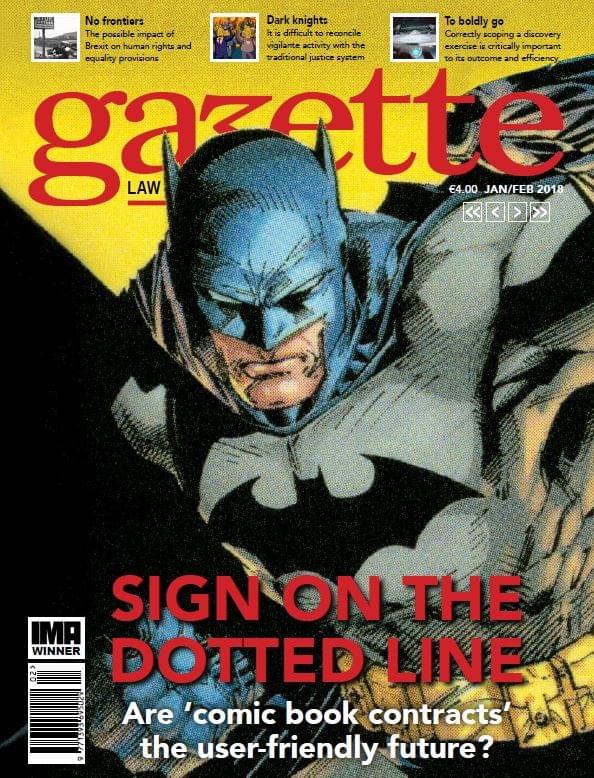
Sign On The Dotted Line: Are 'comic book contracts' the user-friendly future?
The Comic Book Contract movement was front page news on the Irish Law Society Gazette heralded as the future of user-friendly law (there are a few mistakes in this article that the editor has been made aware of).

Our very own Doctor Camilla Andersen gets right to the brunt of it in her write up for The Conversation - pointlessly complex contracts have to stop.
To illustrate her point, Andersen draws upon the impact of needlessly verbose contracts that are impossible to understand while also highlighting how a simple three panel comic formed a full non-disclosure agreement.
Read on here to see Doctor Andersen further discuss the history of the movement and the weird and wacky terms and conditions found in conventional wordy Terms and Conditions!
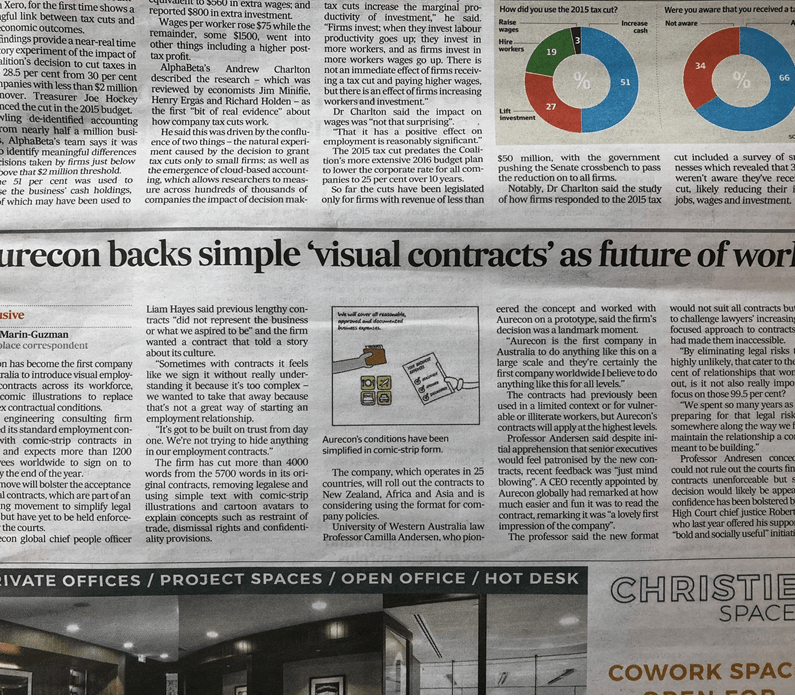
Australian Financial Review
Aurecon backs simple visual contracts as the future of workplace employment contracts on Page 3 of the Australian Financial Review!